0

New workshop for Analytics teams now live!

Logo de l'en-tĂȘte
NewsletterBlog Contact
Ateliers
Principes de conception pour l'analyse
Se connecter
← Back to all posts

How many KPIs are too many?

Feb 24, 2026
Connect

It depends. (ahah!)

KPIs are everywhere.
Across dashboards.
Across reports.

We use them constantly.
And yet, the questions remain.

  • Are they truly KPIs?
  • Are they actually key?
  • Key for others
 or just for us?
  • How many KPIs is reasonable in one company?
  • Are they connected to business strategy?
  • Do decisions happen when they signal something?
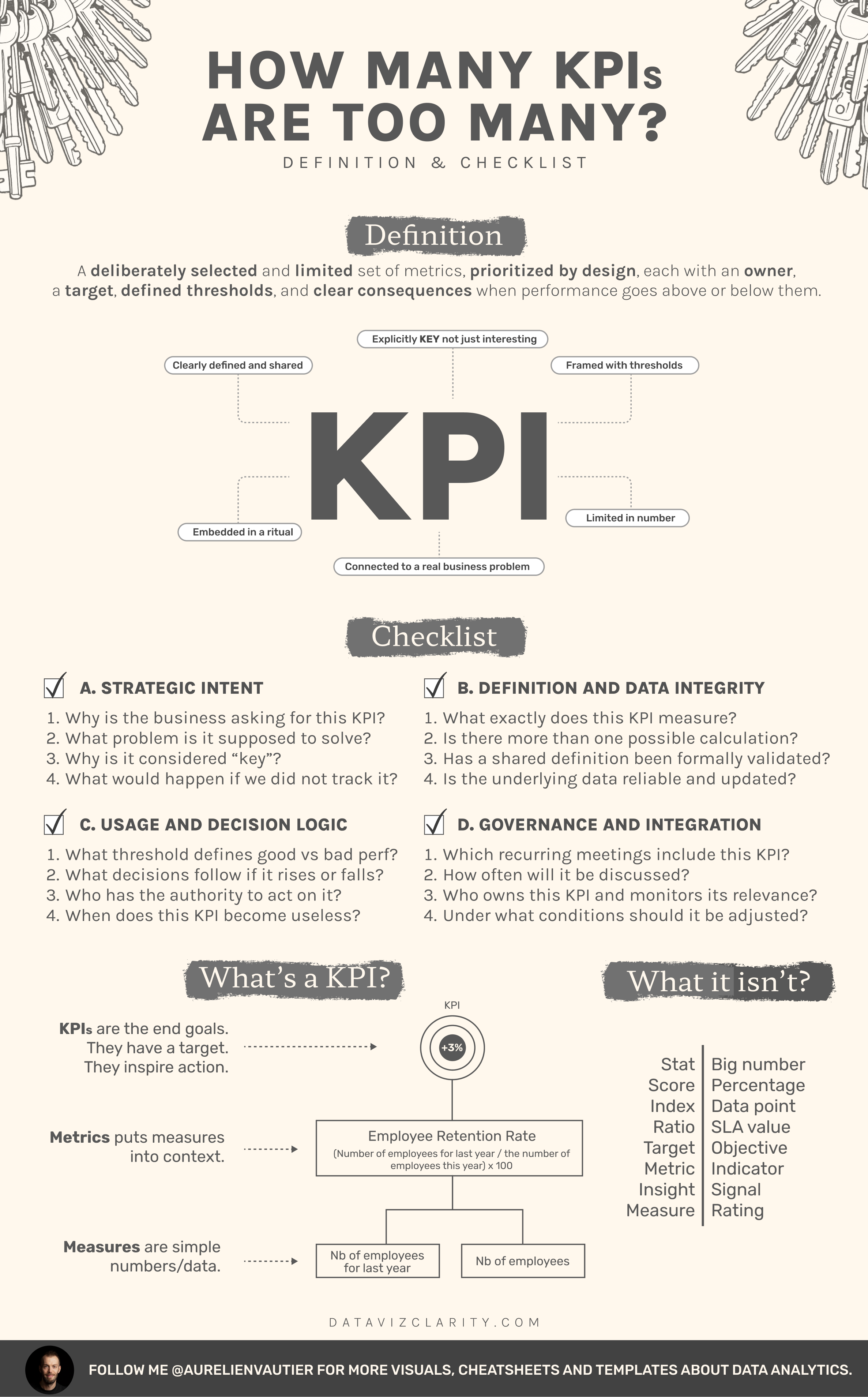
  • A KPI is already a design choice

Click or right click to download

The moment you label a number as "key" you’re making decisions:

  • What matters
  • What gets attention
  • What deserves action
  • What will be reviewed in meetings.

Yet in most organizations, the word gets diluted.

Metric = KPI
Measure = KPI
Score = KPI
Indicator = KPI
Big number = KPI

At that point, KPI just means "a number we decided to show"

And then the list grows.

10 KPIs.
25 KPIs.
50 KPIs.
75 KPIs.

Which leads to a predictable outcome: nothing is prioritized anymore.

When everything is tracked and everything is labeled "key" you’re not prioritizing.

You’re avoiding prioritization.

You’re playing the game of:

  • track everything
  • monitor everything
  • treat everything as urgent

A KPI should exist because it:

  • anchors a business objective

  • drives a decision

  • has an owner

  • triggers action when it moves

If none of that is true, it’s a metric.
Useful, maybe.
But not key.

As a data analyst, if you’re tired of hearing that everything is a priority and everything is urgent, start pushing back.

Explaining that validating a list of 50 KPIs doesn’t create alignment.
It avoids prioritization.
And it helps no one decide what actually matters.    

Take the cheatsheet.
Share it internally.
Use it to challenge how you design KPIs.

If your KPIs don’t trigger action, they need a rethink.

BOOK A CALL WITH ME 

Have a great week everyone!

Responses

Join the conversation
t("newsletters.loading")
Loading...
Data-to-Decision Leakage
*]:pointer-events-auto scroll-mt-(--header-height)" dir="auto" tabindex="-1"> *]:pointer-events-auto scroll-mt-[calc(var(--header-height)+min(200px,max(70px,20svh)))]" dir="auto" tabindex="-1"> Most data teams track what they produce. Number of dashboards.Number of reports.Number of requests delivered. It looks like performance. It’s not. I think most organizations have no idea how much v...
I think most companies don’t really have an Analytics Operating Model. Do you?
*]:pointer-events-auto scroll-mt-(--header-height)" dir="auto" tabindex="-1"> *]:pointer-events-auto scroll-mt-[calc(var(--header-height)+min(200px,max(70px,20svh)))]" dir="auto" tabindex="-1"> Most data team efforts never translate into actual business decisions. Not because they don’t invest.Not because they lack tools or skills. From what I see, it’s more about how everything is struct...
The 48 recurring mistakes in the Data Design Process
*]:pointer-events-auto scroll-mt-(--header-height)" dir="auto" tabindex="-1"> *]:pointer-events-auto scroll-mt-[calc(var(--header-height)+min(200px,max(70px,20svh)))]" dir="auto" tabindex="-1"> Late issue
 but still more timely than most dashboards. For 12 years, I’ve worked with data teams across all kinds of companies. Different industries. Different stacks. Same problem.A lack of metho...

Le dossier de conception du tableau de bord

What you’ll get every Tuesday A series of sharp visuals that decode common mistakes in analytics and dashboard design. Fast to read. Easy to apply. Hard to forget.
Logo en bas de page
Politique de confidentialité Conditions d'utilisation
© 2026 Dataviz Clarity
Propulsé par Kajabi